

No Show
Sometimes missing the main event is just an accident…

Dipping into my diaries from October 2000, I glimpse my family in grief limbo, a few weeks after the stillbirth of my son, Otto.
Excerpt from my diary, October 1st 2000
What was the point of that? I wondered as I was falling asleep last night. Five empty theatre seats where we should have been, on both Friday and Saturday night.
On Friday we had tickets for Béjart Ballet Lausanne’s Ballet For Life at Sadler’s Wells in London. Picked the girls up from school, caught the 4.30pm hovercraft to Portsmouth. At the station, Ian was stuck in a queue for tickets, so the train we hoped to be on had left. The 5.15pm was cancelled. We got on the next “fast” train, due to reach London at 7.04 – tight, but just about manageable (the performance was at 7.30pm). It crawled its way north, due to a defective train ahead of it.
It was too crowded for us all to sit together. I sat next to Ian, until the guy opposite pissed me off by nudging my legs, so I ended up with them tightly tucked in and pretty much numb. Okay, so he had long legs, but I was irritated, wondering if he was deliberately trying to claim the space. When a seat came up next to Alex, I moved.
By the time we approached Guildford, the train was running 40 minutes late and it was becoming clear that, not only would we not make the performance (even if we’d gone in late, there would have been little point as it was due to finish at 9.15), but there’d be no time to do anything at all in London before having to come home.
I asked Olivia, in front of me, to ask Ian (two seats to her left) if there was any point in carrying on with the journey.
“Mummy says, Is there any point carrying on?” she asked him, loudly.
I laughed – it sounded so existential phrased like that – but that stark question struck a chord.
Ian said it was up to me. “Let’s get off at Guildford,” I said. We did, and awaited the next train back to Portsmouth.
“That’s the most pointless Friday night I’ve ever spent in my life,” I said.
It was also the most expensive pointless Friday night. Theatre tickets for five = £150; plus train tickets and hovercraft up and ferry back… But we couldn’t be bothered to get angry – what was the use? We couldn’t change the outcome. (Our resignation felt familiar…)
I looked on the web afterwards for reviews of Ballet For Life. The BBC site mentioned that the opening night on Thursday was packed with ecstatic Queen fans. It’s about the life and death of Freddie Mercury, to music by Queen and Mozart, with costumes by the late Gianni Versace. I thought of our five empty seats in the middle of the stalls on Friday night and wondered if anyone would be curious as to why they weren’t filled during a sell-out performance.
And then last night, I realised as I was going to bed that we were supposed to have gone to the Minghella Theatre in Newport for The Seas of Organillo, a puppet performance by Stephen Mottram, and again we had five tickets. We’d all completely forgotten.
I told Ian. He slumped back in his chair. “Damn!” he said. “Damn!”
I told Alex. “Damn, damn, damn!” she said. We couldn’t believe it.
It looked to be a really inventive piece of theatre, dealing with birth and fertility.
Instead, we had watched The Godfather together on video. An 18 certificate, but I felt the girls (13) would understand it. We had a chat about the complex ethics of it afterwards.
But we should have been in Newport. In that tiny theatre, it would have been even more conspicuous that five people were missing.
So as I drifted off to sleep, I thought: what was the point of that? It felt futile. What was I supposed to learn from it?
In the girls’ school newsletter on Friday, the thought of the week was: “A failure is only a failure if you fail to learn from it.” That’s quite a good one. So what was the point of our weekend failures?
I pictured the five empty seats – the absence where we should have rightfully been. And I thought: it just happened. It was accidental. We didn’t deliberately leave those seats vacant. Maybe that’s what I’m supposed to learn. Otto’s death just happened. The empty space in our lives where he should be is no-one’s fault.
Similarly, on Friday when I took Dill out, I hesitated over whether to extend the walk by turning left, or come home straight away, and turn right.
I turned left, and as the lane was totally quiet and I was nowhere near houses, I let Dill off the lead. She ran into a field of stubble and within seconds she’d found and caught a rabbit. A few seconds later, shaken hard by her, it was dead. My decision to turn left, to remove Dill’s lead, meant a life was gone. That random. That unpredictable.
Accidents happen.
October 5th 2000
Dreamed last night I was searching for Otto again. I looked out to sea and there were the most incredible cloud formations, casting beautiful lights and shapes on the ocean. I marvelled at them and said, “Oh, Otto.” Then human forms appeared in the sky with a crowd of children. Incredible atmosphere – joyous, peaceful, serene. One of them called to – or beckoned – one of the boys, who I already knew was my son, to turn and look at me. It was a momentary distraction, like when a child is playing with friends or a favourite toy and you ask them to stop to say hello to a relative who’s just entered the room. He turned towards me and smiled, and I waved, knowing it was him. And he knew it was me. But he was happy and was eager to get back to his life, his world. Just that moment’s contact. He was about ten in the dream, I suppose, and he looked quite like Ian.
There’s so much soul-searching in my diaries from that time, so many questions without answers, and such vivid dreams – not all of them as comforting as the one I’ve quoted.
I paid for bereavement counselling a few years later. My counsellor reminded me that in a family we all “swim in the same water”. It jolted me into being more open about grief and to check in on my teenage children. It also helped me find the words to explain to Milo, who was born 15 months after Otto, that he’d had an “older” brother who had died as a baby. I broke the news to him when he was three and we were out on a walk, then drew him a family tree when we got home, to help explain.
“There’s a big difference between families that keep secrets and those that don’t,” Milo said to me while we were walking those same country lanes this week.
We were talking about how important it is to be honest with children about death. My grandchildren all attended Ian’s mum’s, “Supernana’s”, funeral early last year. They were also aware that my nephew’s baby, Tyson, died around the same time. Questions that bubbled up at a family barbecue last weekend showed that my granddaughter, R., aged three, hasn’t forgotten. She has a remarkable memory and very caring disposition. My daughter, Becky, tried as best she could to answer her question, “But where did the baby go?”
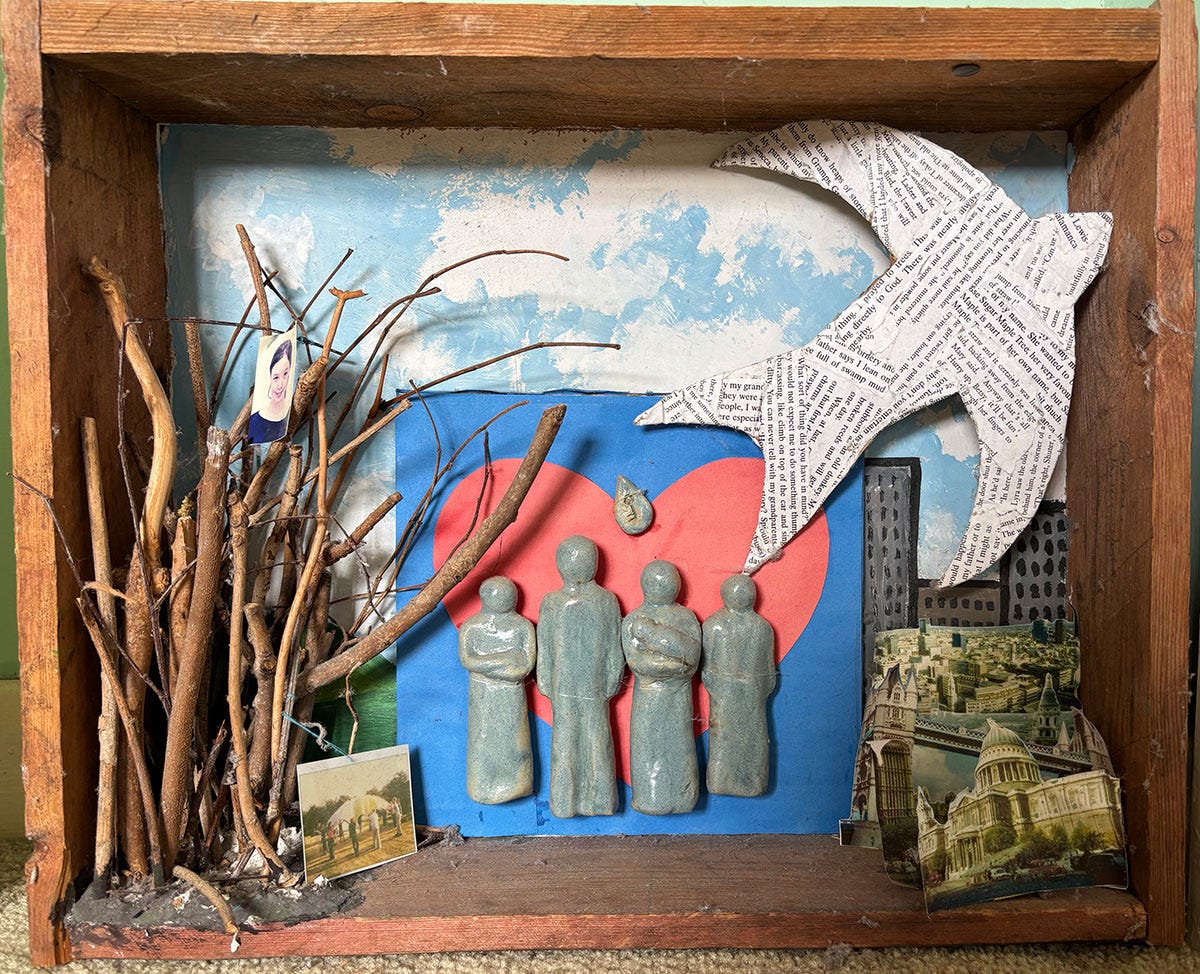
Above: Becky’s ‘My Family’ art project she made when she was fifteen. “But why no sculpture of you?” I asked. “I’m looking in at my family,” she said. She depicted me with Milo in my arms, alongside Ian and her triplet sisters. Otto is represented by the teardrop hovering above us.
Did your family keep secrets from you and if so, how do you feel about it? How do you talk to children about death? Hefty topics, but I’d love to hear your thoughts.
Second Substackversary
Next Thursday 11th June marks exactly two years since I started publishing on Substack and it will be my 100th post. Big thanks to all who read and engage with Wendy’s World – more than 1100 of you. Special thanks to those 20 who’ve chosen to support my writing with a paid subscription (£30/year or £3.50/month) – it really means a lot. New posts are free to read, but most pieces now move into the paid archive after four months, to give my work some protection and keep bots away.
Until next time!
Uh-oh. Just discovered you another gifted writer. I am running out of time in the day to read all of you.
Early grief.
My 16 year old sister died after a three day medical event. Turns out an aneurysm burst in her brain. Aneurysms tend to be a weakness in blood vessel lining from the beginning. A birth defect. My sister had an early bursting.
I was nine.
In a huge subtle way my parents were not the same. Ever again.
Neither was I.
This is usually about all people can tolerate when my sister comes up in conversation.
I shall have to write more about her. And me. And my family.
The wave and smile from your son is one of the most beautiful things I have ever read.