

Fact and Fantasy
On the allure of other worlds. Plus: Yesteryear and Children of the Blitz

I crossed paths with my son Milo at the ferry terminal last Thursday. I was on my way home from London (and yes, I eventually managed to switch off both the smoke machine and the smoke alarm at my daughter’s place, if you were reading last week). I was just in time for the heatwave, mitigated by a merciful sea breeze. He was heading the opposite direction, towards the furnace that was MCM Comic Con, in a costume that involved a shirt, waistcoat, cravat, winter coat and holsters.
On the first day of the convention, Milo offered to pick up his niece from nursery afterwards. “That’d be grea – err, maybe put your guns away first, though,” Becky replied.
“Of course.” (Being mistaken for an actual gangster in East London would be no fun.)
Becky sent the nursery staff a photo of him and advised: “My brother will be collecting R. today. He will be dressed as a sheriff.”
“But who ARE you?” we all wanted to know. “Anyone we’ve heard of?” Depends who you read. He was Wax from Brandon Sanderson’s Cosmere book series and his friend was his sidekick, Wayne.
Brandon Sanderson is a best-selling fantasy author from the US and was making a personal appearance, so his fans were out in force and had no problem identifying Milo’s guise. They queued up to take his photo. As he’s already all over Comic Con’s social media, he gave permission for me to show you his outfit here.
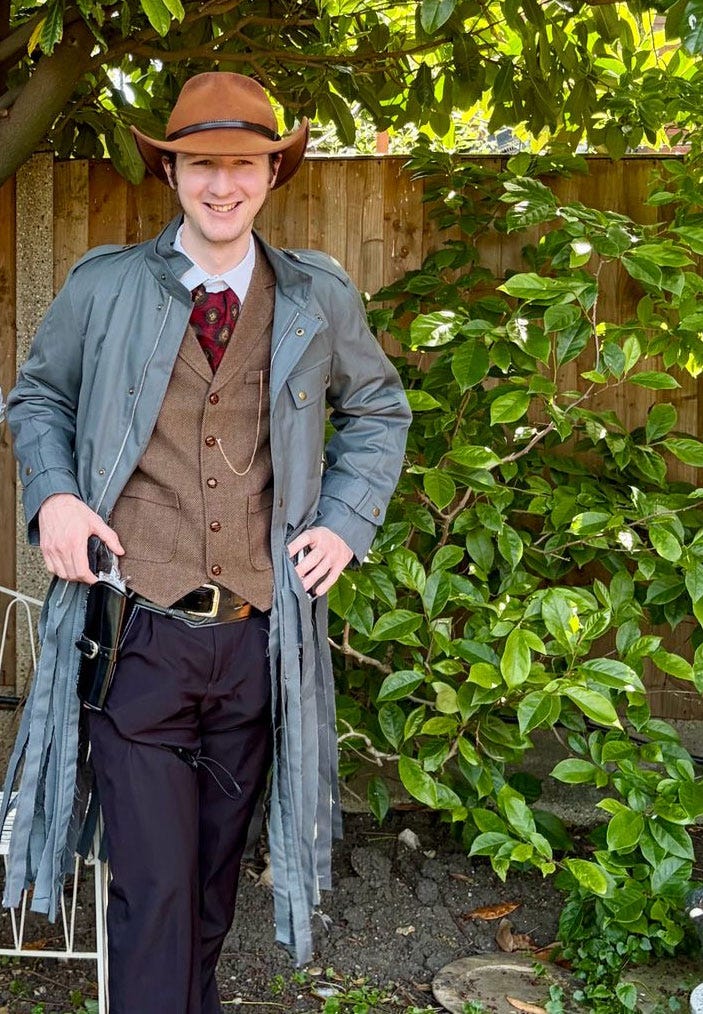
There is more shelf space devoted to Brandon Sanderson books in my house than any other author. He dwarfs the Pratchetts and Rowlings.
I asked Milo what he’d recommend as a taster from Sanderson’s short stories, as I’d never read him. I enjoyed Shadows for Silence in the Forests of Hell, an atmospheric and magical yarn which reminded me of fairy tales I’d loved as a child. The Emperor’s Soul, from the same collection (Arcanum Unbounded) is among Milo’s favourites, but left me underwhelmed. Too long and repetitive for my taste.
We might think no-one under the age of thirty reads any more, but there’s a big appetite for fantasy. For the first time in years, Milo brought home a DC comic book – one of the recent “Absolute” series. He was impressed by the psychedelic style of the artwork and innovative printing that make owning the hard copy appealing. Absolute Martian Manhunter comes with “Martian Vision”: certain pages reveal a hidden background when held up to the light. An effect you can’t replicate online.
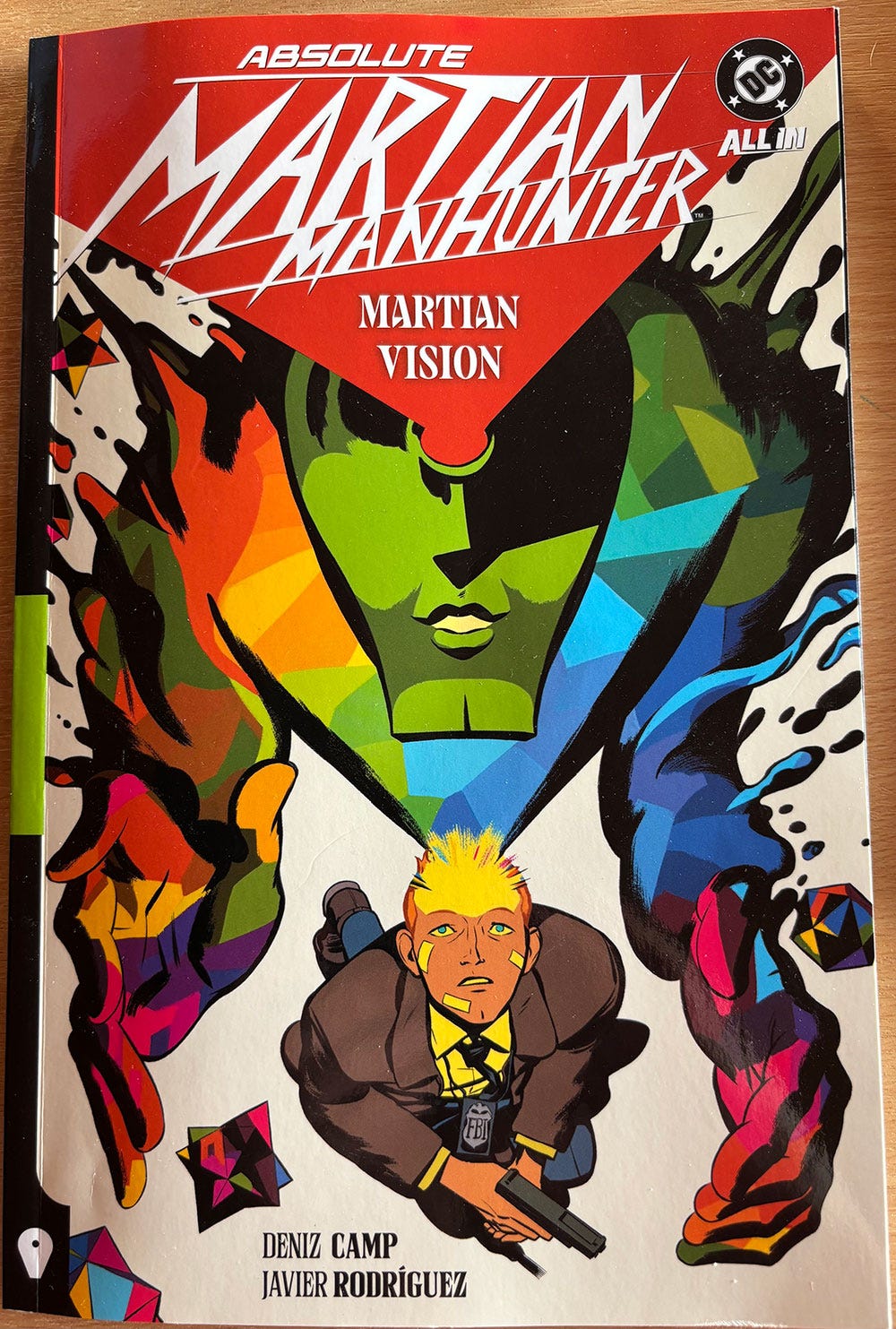
The Absolute series has given its superheroes a modern update (for example, in Absolute Batman, Bruce Wayne is a civil engineer, not born into wealth). It’s apparently revived DC’s fortunes after years of manga hogging the fantasy market.
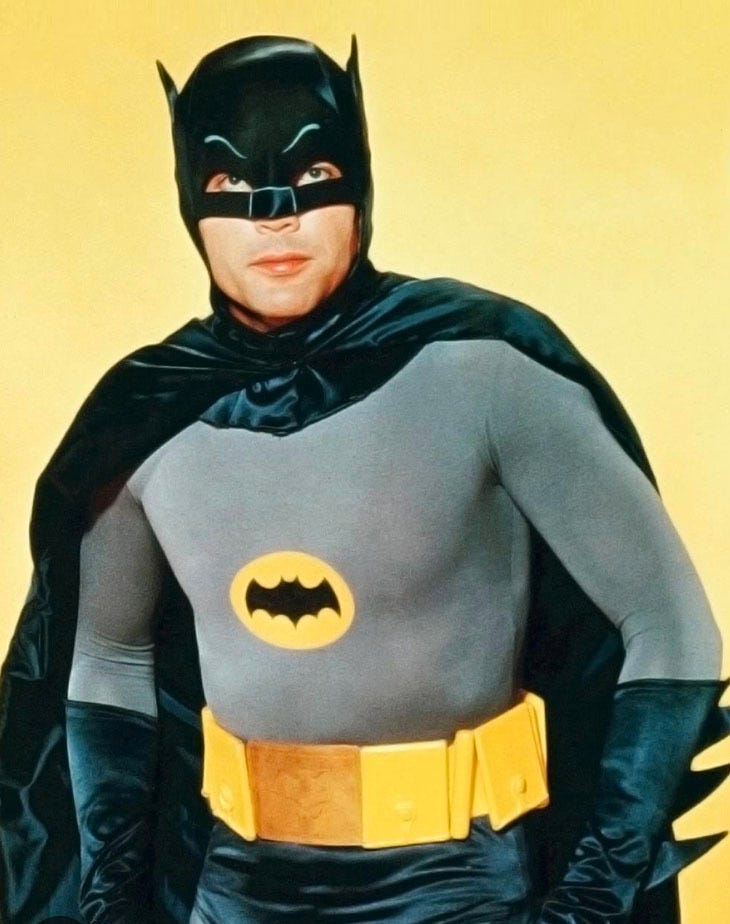
I tend to think I’m not interested in fantasy fiction, and yet it’s what I loved as a child. Fairy tales. Narnia. Anything with a ghost or goblins. And yes, Batman. I was addicted to the 1960s TV series starring Adam West as Bruce Wayne. My first telly crush. (Or maybe, the second, as I was also very fond of Davy Jones of The Monkees.)
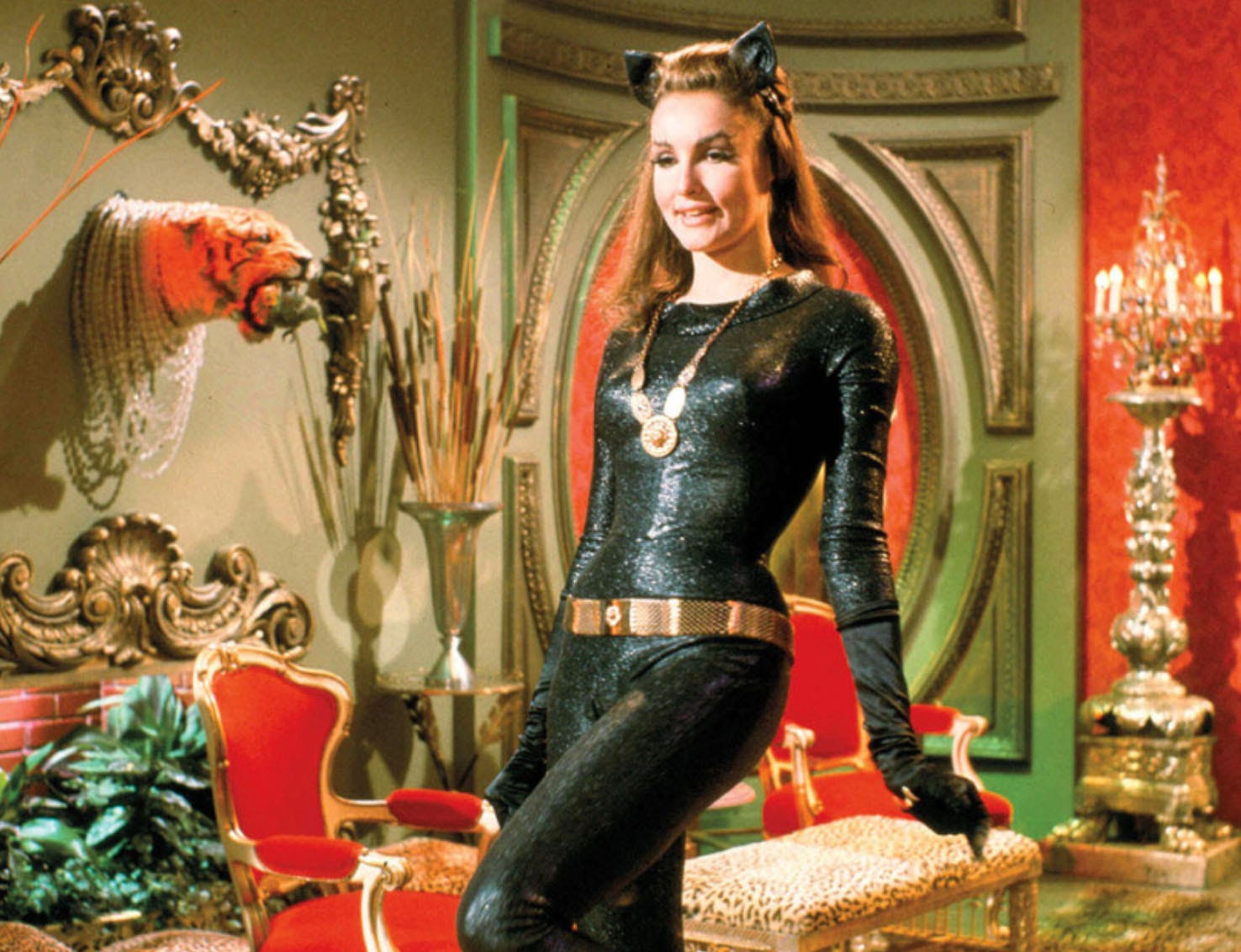
And I wanted to be Julie Newmar as Catwoman. I fought with my friends over who got to play her in our street games.
I adored reading comics and fantasy novels with my children when they were growing up. Maybe I should get back into it and not dismiss it as for the young ’uns. We all need an escape.
How about you? Does fantasy fiction appeal, or leave you cold?
Yesteryear
I read the novel Yesteryear by Caro Claire Burke while I was visiting Holland earlier in the month. Trad wife influencer Natalie finds that she has somehow been transported to actual Yesteryear, an olde-worlde, analogue, mirror-image of her already retro-inspired, but “always on”, modern life.
I enjoyed this review of it by Katie Marquette, which begins:
“I had a weird moment reading Yesteryear, the current book-du-jour on everyone’s bedside table. I was reading about Natalie Heller Mills’ faux trad farm and while I read these things (neglecting the pile of laundry I had meant to fold during quiet time) my husband literally drove by outside our bedroom window on a tractor.”
Katie ponders whether her life is a little bit like Natalie’s.
While in Holland, I had a few jarring moments of my own. In a gorgeous folksy homewares store I found myself coveting pickle jars and table linens, which I know even if I owned them, I’d probably never use. The shop was selling me a dream.
And visiting the farm in southern Holland where my relative’s plane crashed during WWII, I was welcomed by a devoutly Protestant couple and their eleven beautiful children. It struck me that in some ways this was a “trad” family. But the farm and farmhouse were modern and there was nothing performative about any of it. They were just busy living their lives.
I found Yesteryear compelling, but didn’t warm to protagonist Natalie, and I don’t think we’re meant to. Modern social media pressures were well-described, but there’s no real sense of community, so the hollowness of what she’s chasing is what rings out. And the past was sketchy. I found myself wanting more olden times detail and less of the bread-making!
Have you read Yesteryear and, if so, what did you think?
For insights into actual hands-on farming, I enjoy Debbie Kingsley’s weekly notes from her smallholding, and Cecilia At The Kitchens Garden. (I know I’ll think of others the moment I post this…)
Children of the Blitz
I watched the very moving Children of the Blitz documentary on BBC2 (available on iPlayer), about the children who stayed in bombed British cities rather than being evacuated during WWII.
It reminded me that, years before he died, my dad recorded his own memories of the Sheffield Blitz in December 1940. He lived 12 miles from the city centre:
WWII Sheffield Blitz memories by Frank Varley
I lived at Market Street, Hoyland, and was 12 when war broke out. Everyone had to take their gas masks to school everyday. The Blitz at Sheffield was over two nights, Thursday and Sunday.
I was in the cinema watching a film, and sirens went off. They stopped the film and announced that anyone wishing to leave the cinema could do so, but the show would continue.
I stayed and watched the rest of the film.
When I came out I could see all the flashes and bangs over Sheffield, 12 miles away.
I lived a quarter of a mile from the cinema. I got home alright.
One of the days we were in the kitchen. We heard a swish and we all dived under the table but nothing happened. But next day in Market Street, opposite the old Post Office, an anti aircraft shell had gone down a chimney and was unexploded!
We hadn’t a shelter, as only council houses had free shelters, private houses had to pay.
We carried on going to school through the Blitz. I was at Kirk Balk School. All the glass was peppered with shrapnel.
We [children] went to see the war damage in Sheffield on our bikes. Went to Warren Street first. A landmine had landed in a ploughed field near the houses, there was a crater as big as this room, but the field took the blast.
I went on to Sheffield on my own. There was some damage before Wicker Arches, but Wicker Arches to Fitzalan Square was complete devastation. There was a smell of gas and all the damage made me realise what war was and I came straight home.
I didn’t tell my mother where I’d been. She wouldn’t have wanted me to go there.
Gordon update
Arjan Wemmers has sent me the short (six-minute) film he compiled for the exhibition in Holland about Gordon’s life, with English subtitles added. It’s wonderful. I’ve now embedded it in my May 7th piece about the visit.
A journalist from the Sheffield Star has been in touch, so I’m hoping the history of my dad’s Spitfire pilot cousin will now find its way back to his home city. It would be so satisfying to complete that circle in his memory.
Thank you…
for the fun and thoughtful responses to last week’s piece, Swings and roundabouts and ‘Raver Tots’, about the importance of play – and the perils of “smart” homes. Some great points about independence, including the creative spur of having time to be bored.
There was more fun over the scorching bank holiday weekend, when three of the grandchildren came to stay. I deliberately didn’t hover and they were mostly really good about making their own entertainment and resolving their differences.
Please do comment on anything I’ve mentioned today. I love to hear your thoughts.
If you’re enjoying reading and aren’t already a subscriber, please do subscribe.
Until next time!
funny how fiction is labelled, I thought I’d aged out of high fantasy but enjoy gothic, ‘weird’ and speculative fiction and well-written rom-coms all of which explore fantasies (of sorts) or horror. So I might have thought I left behind Terry Pratchett (who I still have a soft spot for) but a lot of my tastes are still fantasy-adjacent. E.g. Rachel Ingalls (‘Mrs Caliban’), Claire Oshetsky’s ‘Chouette’, Barbara Comyns, Shirley Jackson, Katherine Dunn - books that would now be labelled ‘Weird’ I think. For some reason all women, having read a truckload of male-authored fantasy and sci fi in my teens. Enjoyed ‘Wise Children’ by Angela Carter recently, which has a fantastical edge but grounded in a very vivid down-to-earth voice. I’ve appreciated other books I read by Angela Carter without loving them, but Wise Children got me. I think I now want the fantasy elements of any story to be quite earthy, embodied and to do with what it feels like to live in the world rather than purely escapist as such, like ‘Chouette’ totally captured what parenting can FEEL like and went to absurdism to get the feeling across.
I like reading fantasy as well as lots of other stuff and don’t really understand the snobbery around it. A well written book is a well written book. If you don’t mind going back to children’s books, Katherine Rundell’s Impossible Creatures and its sequel will take you right back there. The first book is worth reading just for the extra short story at the end. She’s also done a lovely podcast for the BBC all about. Children’s fiction and how important it is.